Organizations exists because most work requires more than one individual to complete. Communications, coordination, alignment, sharing of knowledge, and the division of capabilities for efficiency and effectiveness are some of the roles of organizations. The operating system of an organization ensures its seamless functioning.
Over the past 22 years, Management Insights has developed and fully documented a methodology, an assessment tool, and an expert system for organizations of any kind to design, develop and transform their operating system in alignment with their strategy, the business model, and the particular management style. We belief that our methodology is unparalleled as it represents the latest science, it fits any organization, and it shortcuts traditional organizational development efforts. Here a summary of the why, what and how of organizational operating systems.
An operating system is a collection of implicit and explicit capabilities that enable people to get work done and ensure the seamless operations at scale throughout an organization. It functions like an organization’s “DNA”, persistent and deeply rooted in the culture such that we don’t even notice it. A well-designed and maintained operating systems serves as:
Organizational operating systems consist of interrelated components: Organization, management, business, leadership, capabilities, people, and work.
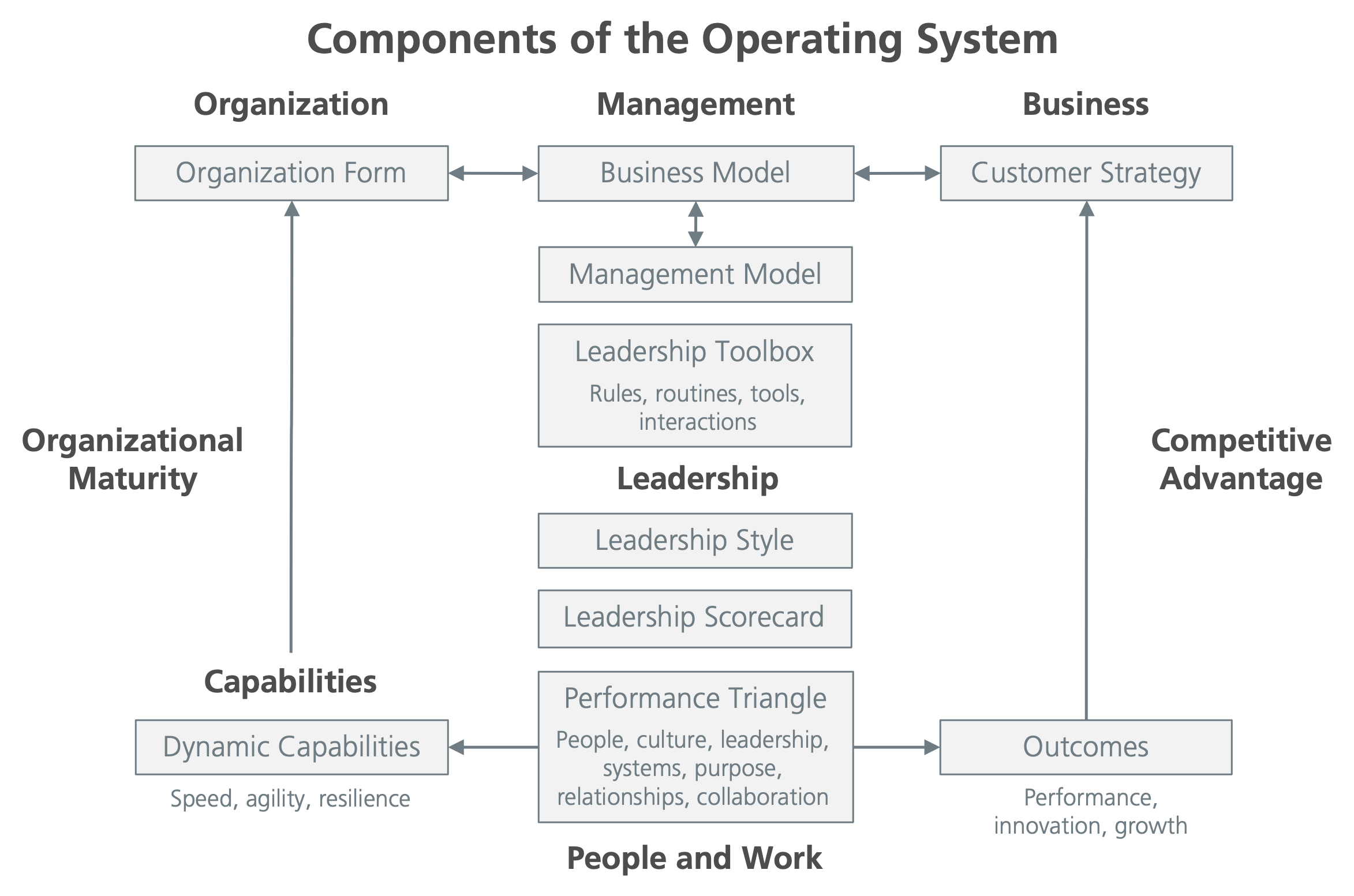
Business is the starting point of every organizational operating system. Its character must reflect the positioning and the core process of the customer strategy. The business model decision follows the strategy with an aligned exploitation, exploration, or a hybrid model. The choice of business model impacts the organization form and with it essential organizational levers. Customer strategy, business model and organization levers determine the management model. The choice of management model determines the capability of the organization to operate in a stable or a dynamic context and by controlling or enabling people.
The leadership toolbox is the host for all rules, routines, tools, and interaction mechanisms. Performance measurement, strategy development, performance management, people engagement and risk management represent an organization’s grand processes. The operating mode, how we do things and how we think about the future, determines the design of the entire toolbox. In a smooth operating system, the leadership style aligns well with the operating mode.
The leadership scorecard and the performance triangle host the culture, leadership, systems, and other intangible factors that enable people to get work done and perform. Dynamic capabilities and outcomes close the loop to organization and the customer strategy.
Five steps help leaders initiate their corporate development initiatives right from their start by adapting the organizational operating system to their needs …
Traditional operating system fixing initiatives have a low rate of success. The evidence from scientific literature confirms our experience: many change projects never see the end, transformation programs don’t reach their goals, engagement efforts fail to enable performance, control systems prevent collaboration, and project management increases rather than decreases complexity.
The generally accepted conclusion is that there is something wrong with traditional management. What has worked well in the past, now fails us in hyper dynamic times and complex contexts. With our research, we have identified 3 main reasons for failure: 1) An obscure baseline at start, 2) Fuzzy purpose of initiatives, 3) Faulty design, no design or untouched design of the managerial operating systems.
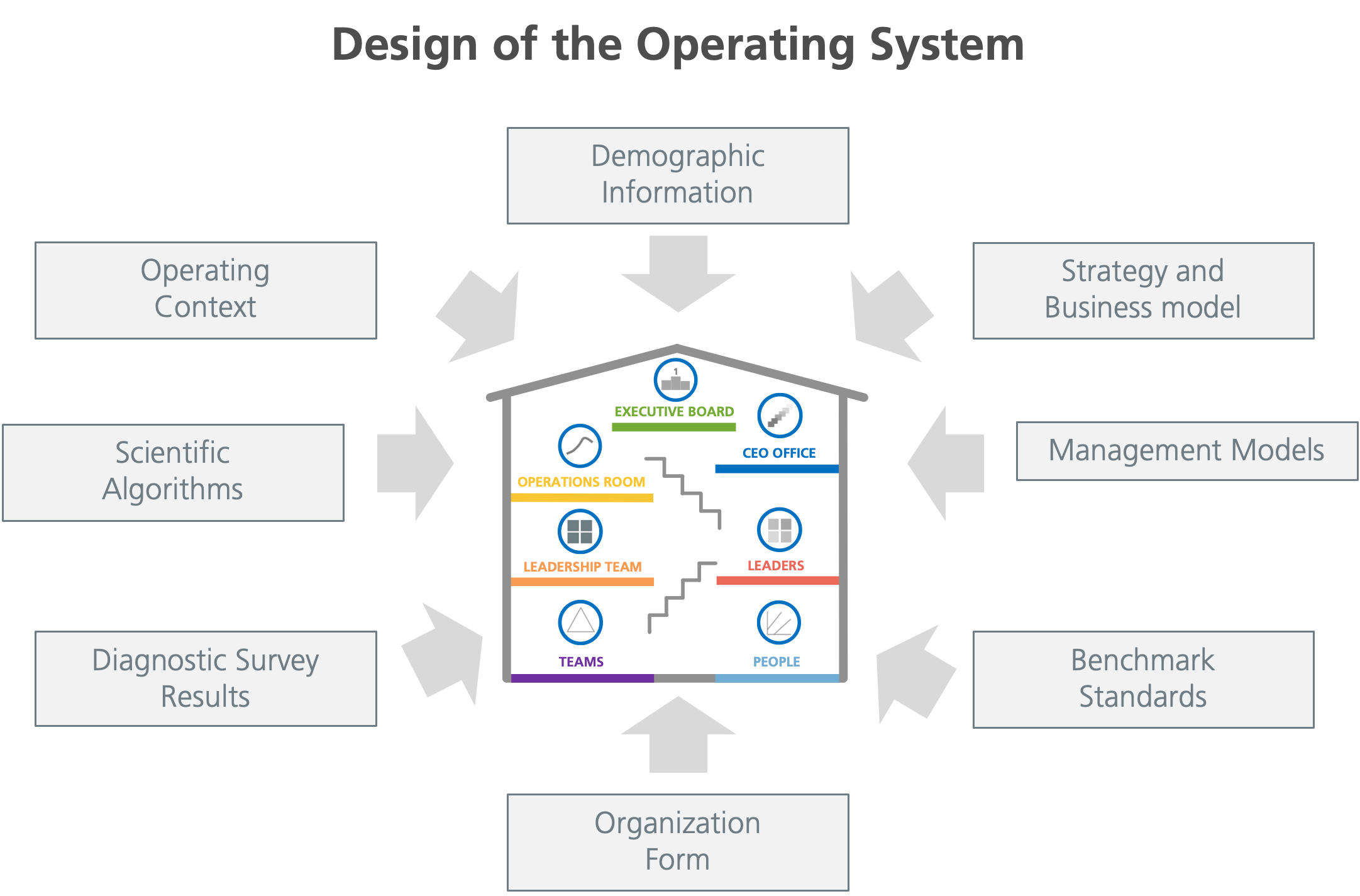
To support operating system development initiatives, we have introduced the Organization Twin Cockpit (OTC), our proprietary, AI-based expert system for the design and the development of operating system based on our capability models, survey diagnostics, standards, statistics, benchmark data, and pattern recognition. The expert system helps users to process the data, view the twin, conduct simulations and scenarios, make design and development decisions, and customize reports.
For our extensive dokumentation, sign-up to our GUEST PORTAL to download brochures on organization twins and operating systems.
About Management Insights
Founded by Lukas Michel, Management Insights draws on more than 25 years of research and practice to help people understand how their organizations work. The Organization Twin brings organizational patterns into view for reflection, dialogue, and informed choice.
Private · Free of charge · Approximately 15 minutes