Over the years, we have learned that the design of management and the development of organizations must be owned by specific groups of people with dedicated roles that organize themselves in spaces: The board, the CEO Office, the operations room, the leadership team, leaders, work teams and people. They all own specific design and development decisions.

To orchestrate these decisions, we have created twin spaces with dedicated areas of responsibilities. spaces contain a series of dedicated decisions. The twin toolbox presents spaces in a way that simplifies the decision-making.
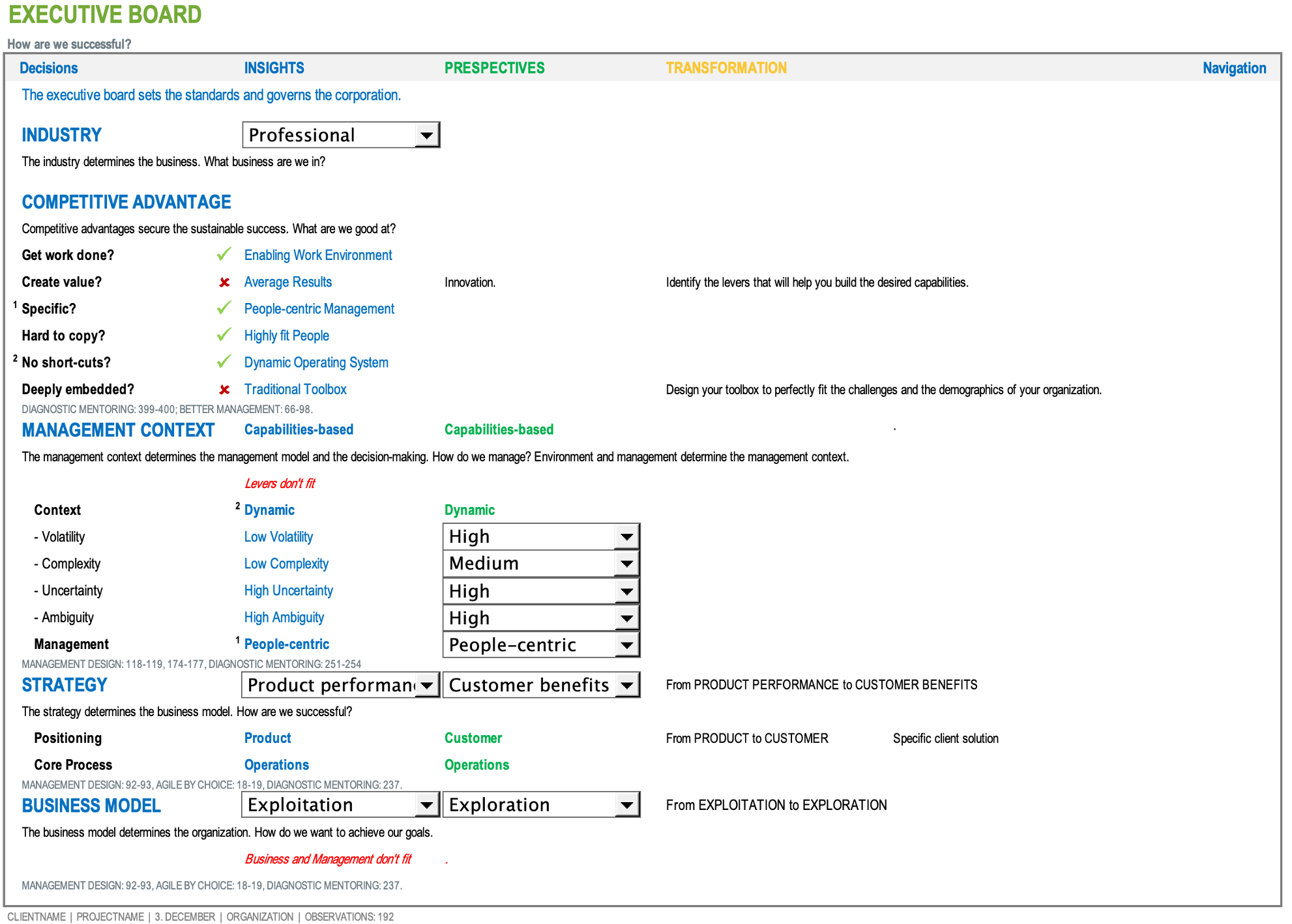
For example the executive board sphere: Their toolbox provides insights on the current state of the organization and decisions for future perspectives on the industry, competitive advantage, management context, strategy and the business model. The twin sphere allows the board to asks the relevant questions on key decisions:
The board's answers modify the twin to incorporate their decisions for the current state and its perspectives. With this, the toolbox returns suggestions for the transformation.
Correspondingly, the board's decisions refines the twin for the CEO Office, the operations room, the leadership team, leaders, work teams and people to guide their decisions.
As such, the work with the twin and toolbox follows the order of the spaces (top-down) and returns to the top (bottom-up). That strengthens the alignment of management and organization across all spaces.
About Management Insights
Founded by Lukas Michel, Management Insights draws on more than 25 years of research and practice to help people understand how their organizations work. The Organization Twin brings organizational patterns into view for reflection, dialogue, and informed choice.
Private · Free of charge · Approximately 15 minutes
 |
|
 |
| Publiziert: 08:47:18 03.01.2024 | Management Insights, Lukas Michel |