Every board member knows the unsettling moment when a crisis erupts seemingly out of nowhere: a sudden financial deficit, a large project doubling in cost, a regulatory breach, a supply-chain collapse, or an unexpected leadership meltdown. Boards describe these events as “surprises,” but they rarely are. In nearly every case, the signals were present long before the crisis hit — but they appeared outside the traditional reporting structures that boards rely on.
Behind every crisis lies something deeper and more systemic:
an unmanaged management system.
Unmanaged does not mean “no one is in charge.” It means something much more subtle:
a management system that is incomplete, outdated, misaligned, or incapable of coping with complexity. These unmanaged states accumulate silently and only become visible when they cross a threshold — often as a board-level event. When such failures reach the board table, the damage is usually already done.
Boards can no longer rely on dashboard summaries, heroic leadership narratives, or green-light traffic light systems. They need a new capability: the ability to sense unmanaged patterns in the management system long before they trigger a crisis.
This is where the Board Governance Heatmap comes in — a new tool that visualizes how unmanaged risks cluster across the 18 Organization Twin dimensions. It gives boards an early-warning system grounded in 25 years of research, 500 organizations, and a scientifically plausible risk-weighting model.
Boards sit at the far edge of the governance system. They see organizations through:
Yet unmanaged situations emerge in the middle of the operating system — in decisions, culture, capabilities, and real-time responses. That is where:
do their damage.
Boards rarely see this until it manifests as a major failure.
The World Economic Forum, the Institute of Internal Auditors, McKinsey, and regulators around the world increasingly warn that boards must oversee not just performance but the health of the management system itself. Boards must ask:
“Is our management system fit for a world of complexity?”
This question cannot be answered with KPIs alone. It requires a different lens.
To give boards this lens, we built a risk-weighted heatmap across the real Organization Twin dimensions:
These 18 dimensions represent how work actually gets done. They are the architecture of management — the true levers of performance and resilience.
Using your expert weighting logic, we scored each board-level unmanaged situation from 1 (small unmanaged risk) to 5 (large unmanaged risk). The result is a science-based early-warning map showing where unmanaged states cluster.
The Board Heatmap
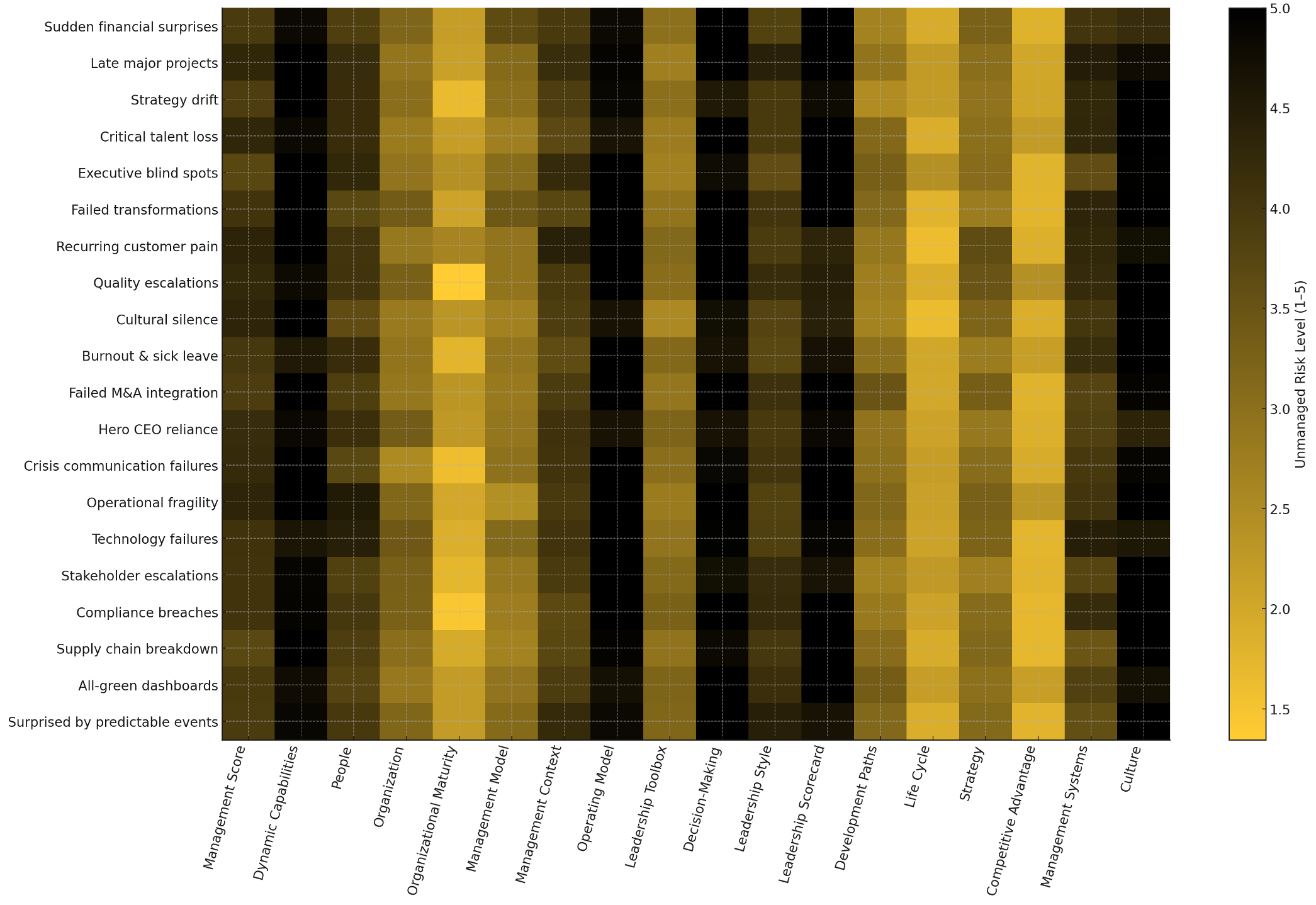
Across 500 organizations, 20 unmanaged patterns repeat consistently at the board level:
These are not simply operational issues. They are signals of unmanaged management systems.
The heatmap reveals four major insights for board governance:
Insight 1: Dynamic Capabilities and Decision-Making Are the Epicenter of Failure
Across all 20 unmanaged board events, the highest-risk clusters appear in:
This means unmanaged crises usually begin where:
Boards must therefore govern capability health, not just KPIs.
Insight 2: Culture Is a Governance System — Not an HR Topic
“Culture” surfaces prominently in the heatmap. Why?
Because culture determines:
Boards are responsible for overseeing culture, not managing it — and unmanaged culture is one of the most consistent roots of crisis.
Insight 3: Leadership Systems Matter More Than Individual Leaders
The heatmap highlights:
These are systemic leadership elements. They predict:
Boards often assess the CEO, but rarely the leadership system. The heatmap makes visible what was previously invisible: leadership is a team capability, not an individual trait.
Insight 4: Management Systems Predict Performance Better Than Financial KPIs
The strongest board-level crises — compliance failures, IT outages, supply chain collapses — correlate strongly with unmanaged:
Financial KPIs lag.
Management systems lead.
Boards cannot wait for financial symptoms; they must govern the system logic that produces performance.
Traditional governance models assume:
But today’s environments are:
The Organization Twin — the digital diagnostic of the management system — is designed precisely for this reality. It gives boards:
It replaces guesswork with evidence.
It replaces politics with patterns.
It replaces crisis response with prevention.
Boards finally get what they always lacked:
a safe, objective model to oversee management quality.
Based on the heatmap, boards have a new mandate:
1. Oversight of Dynamic Capabilities
Boards must ensure the organization can sense, decide, act, learn, and adapt — continuously.
2. Oversight of Decision-Making Architecture
Clear roles, transparent criteria, timely escalation, and cross-functional steering must be in place.
3. Oversight of Leadership Systems
The board must monitor leadership behavior as a system, not individuals.
4. Oversight of Culture
Boards must ensure culture supports:
5. Oversight of Resilience and Operating Models
Boards must ensure the operating model is not optimized for efficiency at the expense of resilience.
Step 1 — Diagnose the Management System with the Global Executive Survey
This gives the board empirical data on the management system across 135 points.
Step 2 — Visualize Weaknesses with the Organization Twin
The Twin shows:
where unmanaged risks cluster,
where decision bottlenecks form,
where critical capabilities are missing.
Step 3 — Discuss the Heatmap with the Executive Team
Instead of discussing people, boards discuss patterns.
This creates psychological safety and reduces defensiveness.
Step 4 — Define Management Expectations Using the Mastery Attributes
Boards set standards for:
Step 5 — Monitor Management Health as a Strategic Asset
Management capability becomes a dashboard — not an afterthought.
Boards cannot continue relying solely on:
These tools are too limited for today’s complexity.
The Board Governance Heatmap, combined with the Global Executive Survey and Organization Twin, gives boards the missing capability:
oversight of the management system.
This is more than risk management.
It is strategic foresight.
It is resilience engineering.
It is performance assurance.
It is good governance.
Most importantly, it replaces reactive governance with proactive stewardship.
Crisis-driven governance is no longer acceptable.
Boards need tools that reveal unmanaged systems long before they become crises.
The Board Governance Heatmap shows where unmanaged risks live.
The Organization Twin makes them understandable.
The Global Executive Survey makes them measurable.
The Mastery framework makes them solvable.
We no longer need to be surprised by predictable events.
Boards can finally see the truth of the management system — and act before it is too late.
 |
|
 |
| Publiziert: 16:49:26 24.11.2025 | Management Insights, Lukas Michel |