
Why Traditional Performance Models Are Failing
For decades, organizations have measured success through efficiency, rigid KPIs, and hierarchical control. While these methods may have worked in stable environments, they are failing in today’s fast-changing, complex world. Businesses that focus only on efficiency often struggle with rigid structures, slow decision-making, and disengaged employees—leading to short-term success but long-term instability.
What if performance wasn’t just about optimizing for efficiency, but about creating a system that is adaptable, resilient, and human-centered? This is where The Performance Triangle comes in.
The Three Dimensions of The Performance Triangle
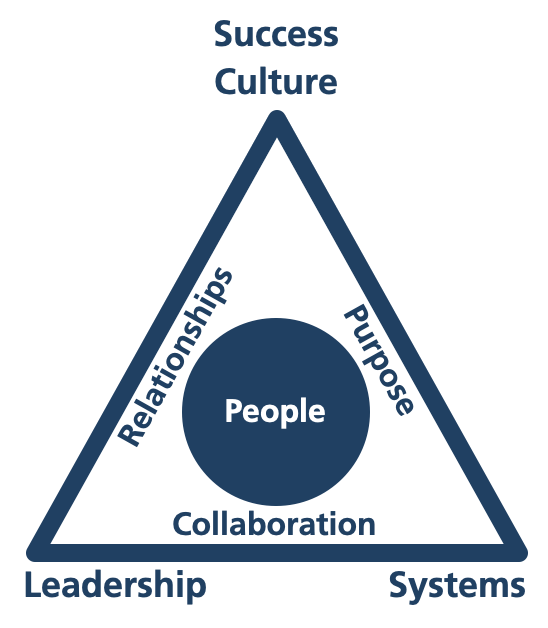 Instead of focusing solely on output and control, The Performance Triangle provides a balanced, integrated approach to high performance by aligning leadership, systems, and culture. When these three dimensions are in sync, organizations can thrive in uncertainty while fostering sustained innovation and engagement.
1. Leadership: Enabling Performance, Not Controlling It
Traditional leadership is based on command-and-control thinking—leaders make decisions, and employees follow. However, modern organizations require leaders who enable performance rather than dictate it.
♦ Key shifts in leadership:
- Moving from hierarchical control to empowered, decentralized decision-making.
- Creating psychological safety, where employees feel encouraged to take risks and innovate.
- Acting as a facilitator of change, rather than the sole decision-maker.
2. Systems: Creating Agility and Adaptability
Organizations are not mechanical structures—they are living, evolving systems. Many businesses still operate under rigid bureaucracies, which slow down decision-making and make adaptation difficult.
♦ Key shifts in systems thinking:
- Moving from rigid processes to flexible, interconnected networks.
- Designing systems with continuous learning loops, ensuring they evolve over time.
- Prioritizing collaboration over silos, allowing for cross-functional problem-solving.
3. Culture: The Invisible Force Behind Performance
Culture is often seen as a soft factor, but it is the glue that holds organizations together. A high-performing culture is not just about engagement—it is about aligning behaviors, values, and collaboration with strategic goals.
♦ Key shifts in cultural management:
- Moving from compliance-based cultures to trust-driven cultures.
- Encouraging open feedback and continuous learning.
- Aligning culture with leadership and systems, so that employees feel connected to the organization’s purpose.
Why The Performance Triangle Matters
Many organizations over-focus on one dimension—for example, strong leadership but weak systems, or high engagement but poor decision-making. When one element is missing, performance is unsustainable. However, organizations that integrate leadership, systems, and culture create a foundation for long-term success.
✅ With strong leadership, employees are empowered.
✅ With agile systems, organizations adapt faster.
✅ With a trust-based culture, collaboration and innovation thrive.
Implementing The Performance Triangle in Your Organization
1️⃣ Assess Your Current Approach – Are you over-reliant on rigid structures or outdated leadership models? Identify gaps in leadership, systems, or culture.
2️⃣ Redesign Leadership Roles – Move from directive leadership to facilitative leadership, empowering employees to make decisions.
3️⃣ Make Systems More Adaptive – Shift from fixed processes to agile frameworks that allow for continuous improvement.
4️⃣ Strengthen Cultural Alignment – Ensure that the values, collaboration models, and decision-making processes align with the overall business strategy.
5️⃣ Use Data to Measure Impact – The Organization Twin can help leaders track, visualize, and optimize the integration of leadership, systems, and culture.
Final Thought: A New Era of Performance Management
The future of organizational success isn’t about short-term efficiency—it’s about long-term adaptability. The Performance Triangle provides a practical, integrated approach for organizations looking to move beyond outdated industrial-era management and towards a sustainable, people-centric, and high-performing future.
Is Your Organization Ready for The Performance Triangle?
Assess your leadership, systems, and culture today to see how well they align—and start building a more resilient and adaptable organization!
Learn more about the Performance Triangle in our book.
About Management Insights
Management Insights supports leaders, boards, and consultants in gaining clarity about how management actually works in their organizations.
The work builds on more than 25 years of research and practice and centers on the Organization Twin—an evidence-based way of making organizational patterns visible without judgment or exposure.
Rather than prescribing solutions, Management Insights focuses on learning, reflection, and the development of mastery in management.
Those interested in exploring their own context typically begin with a Guided Clarity Session.
Lukas Michel is a management researcher, author, and founder of Management Insights. His work documents the journey from unmanaged organizational reality to mastery in management.